The fastest way to get a fake social media account impersonating your brand removed is to use the platform's impersonation or trademark reporting channel with an evidence-backed report. The report includes the account link, a comparison with your official account and your trademark registration details. In Türkiye, large social network providers must answer applications within the period set by Law No. 5651; if that brings no result, the routes under Industrial Property Law No. 6769 are open. A lasting result comes from spotting early when the same person returns with new accounts.
Why are fake brand accounts opened?
Not every fake account sells fake products. What sets the priority is what the account does:
- Accounts collecting payments or personal data: giveaways that appear to be run in the brand's name and ask for payment or information to take part, accounts that reply as the "support team" to users complaining to the brand and collect their details, profiles that drive traffic to a phishing site. These go to the top of the list because the harm falls directly on users.
- Accounts selling products: shop accounts that take orders by message using original product images. Whether the product is fake, or genuine but unauthorized, is examined separately.
- Accounts causing reputational harm: accounts posting misleading or offensive content in the brand's voice.
- Fan pages using the logo without permission: often resolved by direct contact rather than a report.
How can you tell an account is fake?
No single sign is enough; when several come together, the account is most likely not official. An extra dot or underscore in the username, suffixes such as "official", "support" or "tr", or lookalike characters. A profile opened recently but full of brand content. Links leading to another domain or a messaging app instead of the brand's official site. Orders, payments or "you've won" messages handled only through private messages.
The simplest step the brand can take itself is to publish the list of its official accounts on its website. Users and platform moderators alike check against that list.
How should you report to the platform?
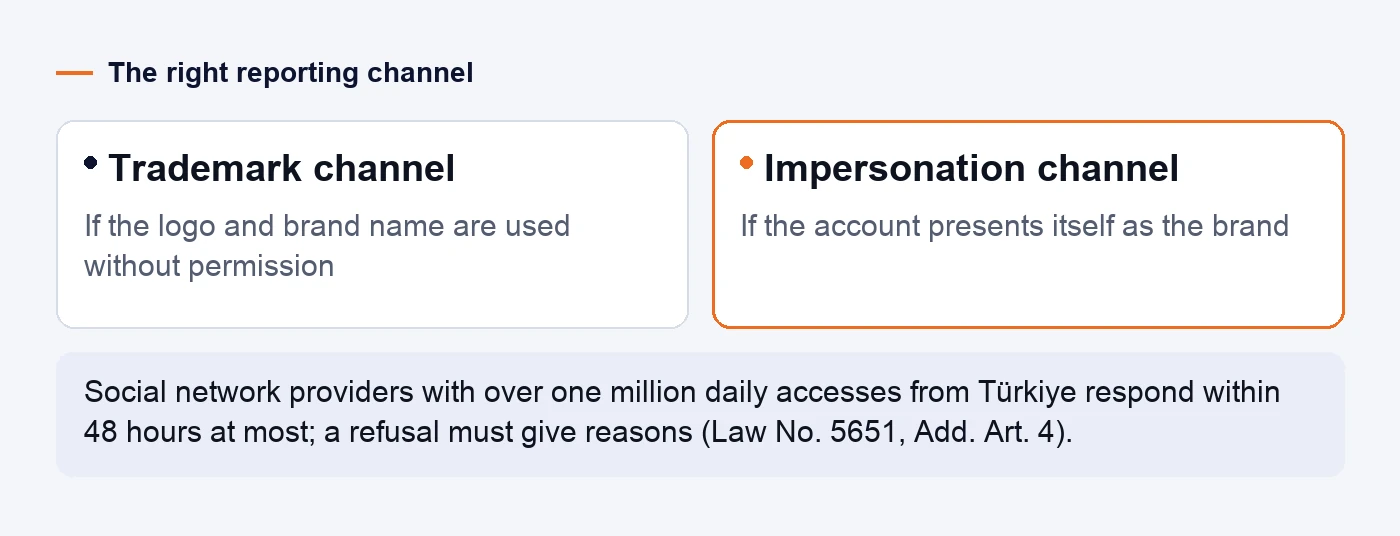
Large platforms usually offer separate channels for impersonation and for intellectual property infringement. If the logo and brand name are being used without permission, the trademark channel fits better; if the account presents itself directly as the brand, the impersonation channel does. A report sent through the wrong channel often comes back with a "please use the relevant form" reply and costs time.
In Türkiye, Additional Article 4 of Law No. 5651, as amended by Law No. 7578 in 2026, requires social network providers with more than one million daily accesses from Türkiye to respond to applications positively or negatively within 48 hours at most, and to give reasons for a negative response. A reasoned refusal is a document that can also be used at the next stage of the file. For platforms operating in the EU, the notice requirements of the Digital Services Act (2022/2065) also apply; we cover them in detail in the article on marketplace complaints.
A good report file contains:
- Full links to the fake account and the posts concerned.
- Dated screenshots showing the username, profile information and posts.
- The link to the official account and a short explanation of the similarities between the two.
- The trademark registration number and the classes of goods and services it covers.
- Any complaints showing that users have been harmed.
What legal routes exist if the report fails?
Article 7 of Industrial Property Law No. 6769 gives the trademark owner the right to prevent unauthorized use in trade of a sign identical or confusingly similar to the registered mark; the uses that can be prohibited include use in advertising and use online in a way that has commercial effect. Article 29 treats these uses as trademark infringement. For accounts that sell products, the criminal sanction in Article 30 may also come into play; investigation of these offences depends on a complaint, and the trademark must be registered in Türkiye.
The legal route takes longer than a platform report, but in repeated and organized cases it is the one that gives a lasting result. That is why evidence gathered at the reporting stage must be fit for a court file as well: dated, with a known source, and unaltered.
Why should a closed account still be watched?
Removing an account does not mean the person behind it has given up. New accounts opened with the same images, the same description, the same redirect link or the same contact number often belong to a single person or group. To make that connection, each case is recorded: which account, when it was detected, through which channel it was reported, when it was removed and which common traces it carried. If a new account carries the phone number or link from earlier cases, the report is made showing that connection.
A social media account often drives traffic to a marketplace shop, an ad or a domain resembling the brand. The reasons for monitoring channels together are set out in the channels digital brand protection needs to cover.
How does Authex manage this process?
Authex monitors fake accounts and pages, brand identity impersonation and unauthorized social selling on social media. Detected accounts are documented with the source link, a timestamp and, where possible, a screenshot, prioritized by risk level and assigned to team members. The reporting and takedown process is tracked until it is resolved, and removed content is watched in case it goes live again. Where a lawsuit or criminal complaint is needed, the legal assessment belongs to a trademark attorney or lawyer. Details are on the solutions page.