
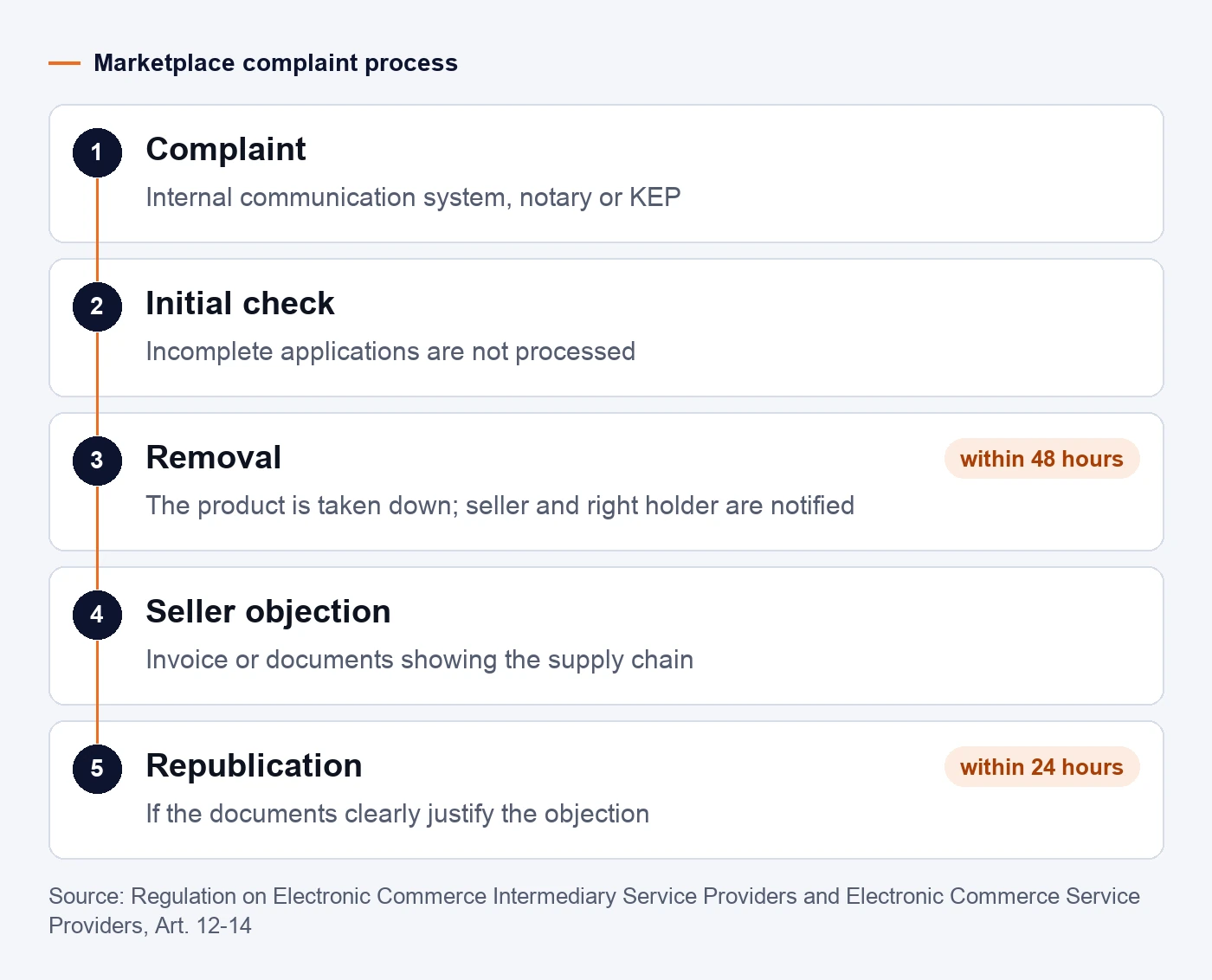
In Türkiye, for a fake product on a marketplace that infringes your trademark, you can send a complaint containing your registration certificate and evidence of infringement directly to the marketplace. Under Law No. 6563 on the Regulation of Electronic Commerce and its implementing regulation, the marketplace removes the product within 48 hours of a complete complaint and gives the seller the opportunity to object. If the seller documents that the product is genuine, it comes back within 24 hours; so the outcome is often decided by the strength of the first file. The court and public prosecutor routes remain open independently of this process.
Which law does the right to complain rest on?
The main basis is Article 9 of Law No. 6563, as amended by Law No. 7416 in 2022. It provides that an electronic commerce intermediary service provider, meaning the marketplace, removes the product on a complaint based on information and documents showing an infringement of intellectual and industrial property rights, and notifies the seller and the right holder. If the seller objects with documents showing the contrary, the product is published again.
The right itself arises from Industrial Property Law No. 6769. Article 7 gives the trademark owner the right to prevent unauthorized use of a registered mark, Article 29 treats such uses and the sale of products bearing a counterfeit mark as trademark infringement, and Article 30 sets out the criminal sanction. The criminal route depends on a complaint and requires the trademark to be registered in Türkiye.
What information and documents should the complaint include?
Under Article 12 of the Regulation on Electronic Commerce Intermediary Service Providers and Electronic Commerce Service Providers, the complaint is made through the marketplace's internal communication system, a notary or registered electronic mail (KEP) and includes:
- Proof of ownership: the registration certificate issued by the Turkish Patent and Trademark Office (for copyright, a banderole form or a collecting society activity certificate).
- Identity and contact details: for legal entities, the trade name, address, email and KEP address if any; a power of attorney if a representative applies.
- Grounds and evidence: an explanation of why the product infringes intellectual and industrial property rights, with supporting evidence.
- Web address: the link showing the product complained of.
- Statement of responsibility: a statement that the applicant is liable for damages arising if the information is untrue.
If any of these is missing, the marketplace does not process the application and notifies the applicant of the deficiency. In practice the part most often left thin is the grounds: saying "the product is fake" does not take the place of showing why it is fake.
How quickly does the marketplace act?
Under the Regulation, the marketplace removes the product without delay and no later than 48 hours after receiving the complaint, and notifies the seller and the right holder. The notice to the seller sets out the ways to object.
A seller who objects submits an invoice showing the product is genuine, or a contract or documents showing it was bought from the right holder or from those who placed it on the market with the right holder's consent. If the documents clearly show the objection is justified, the product is published again within 24 hours at most. After that, a new complaint about the same product and claim is not processed unless new documents proving the infringement are submitted. A weak first complaint therefore also makes a second attempt on the same listing harder.
The marketplace's review is limited to the documents submitted by the seller; the parties' right to go to court under general provisions is reserved in all cases.
Can the unauthorized sale of a genuine product also be reported?
Not every unauthorized sale is trademark infringement. Article 152 of the Industrial Property Law provides that acts relating to products placed on the market by the right holder, or with the right holder's consent, fall outside the scope of the right; commercial use of the product after it has been altered or impaired is the exception. A complaint about a genuine product sourced outside the authorized channel is likely to fail against the seller's objection with an invoice, and because of the rule above it may also close the door to a second complaint.
That is why the finding is classified before the complaint: the product may be fake, or genuine but sourced from an unauthorized channel. In the second case the matter is often one for the distributor agreement rather than trademark law. Why the distinction is decisive is explained in the article on authorized and unauthorized use.
What changes on marketplaces outside Türkiye?
For platforms operating in the EU, the framework is the Digital Services Act (DSA, 2022/2065), fully applicable since 17 February 2024. Article 16 requires hosting service providers to set up a mechanism through which illegal content can easily be reported electronically. A notice carries four elements: a sufficiently substantiated explanation of why the content is illegal, the exact electronic location such as the full URL, the name and email address of the person submitting it, and a statement of good faith that the information is accurate and complete. The platform sends a confirmation of receipt and its decision without undue delay. Article 22 provides that notices from organizations with "trusted flagger" status are given priority.
The difference from the Turkish regulation is that the DSA sets no fixed number of hours and puts the substantiated explanation, rather than the registration certificate, at the centre. The certificate should still be in the file; it is the strongest basis for the explanation.
How should evidence be prepared?
The file is prepared so that it also holds up against the seller's objection:
- the listing link, a screenshot and the time of detection,
- the seller's shop name and identity details on the platform,
- the price, product images and description text, and the differences from the genuine product,
- where available, the product, invoice and packaging photos from a test purchase,
- a note showing that the classes of goods and services in the registration certificate match the product in the listing.
A test purchase is often the strongest evidence: the product is physically in your hands, and its invoice can be compared with the documents the seller will submit in an objection.
What happens if a removed listing comes back?
A removed listing can soon be replaced by a new one from another account. The same images, the same description or the same pricing pattern link the new listing to the earlier case, and that link is shown in the new complaint. For this, every complaint has to be recorded with its date, its outcome and the document the seller submitted in any objection.
Authex monitors listings made in the brand's name on marketplaces and independent e-commerce sites; it documents suspicious listings with the source link, a timestamp and, where possible, a screenshot, compares them with the authorized seller list and ranks them by risk level. Findings are assigned to team members and takedown notices are tracked until they are resolved. Classifying a listing as fake or as an unauthorized sale, and any legal steps, are decisions for the brand owner and its attorney. The scope is on the solutions page.
Sources
- Law No. 6563 on the Regulation of Electronic Commerce (mevzuat.gov.tr, in Turkish)
- Regulation on Electronic Commerce Intermediary Service Providers and Electronic Commerce Service Providers, Official Gazette, 29 December 2022, No. 32058 (in Turkish)
- Industrial Property Law No. 6769 (mevzuat.gov.tr, in Turkish)
- Regulation (EU) 2022/2065, Digital Services Act (EUR-Lex)