Cybersquatting is the bad-faith registration and use, by someone with no right to it, of a domain name identical or confusingly similar to a brand. For generic extensions such as .com, ICANN's UDRP policy, and for the .tr extension, the dispute resolution mechanism in Türkiye's Internet Domain Names Regulation make it possible to have a domain cancelled or transferred without going to court. Both routes examine similarity, lack of rights and bad faith; under the .tr rules it is enough to show bad faith in either registration or use.
What forms do domain names targeting a brand take?
The patterns are familiar:
- Typosquatting: names with a letter missing, added or swapped.
- Names with added words: words such as "discount", "outlet", "support", "login" or "tr" attached to the brand name.
- Other extensions: the same name registered under other extensions while the brand uses a .com.tr address.
- Lookalike characters: names that look identical but are technically written with different characters.
- Dropped domains: an old address the brand forgot to renew, picked up by someone else.
The purpose varies too: a copycat shop selling fakes, a phishing page collecting user data, redirecting traffic to a competitor or an ad network, or the hope of selling the domain to the brand. That purpose decides which route to take and what to put at the front of the file.
The number of disputes is climbing. On 14 January 2026 the World Intellectual Property Organization (WIPO) announced that it had administered more than 6,200 domain name disputes in 2025, the highest number of cases on record. The figure covers only disputes brought to WIPO; names that are registered, used briefly and abandoned are not counted.
What can be done for .com and other generic extensions?
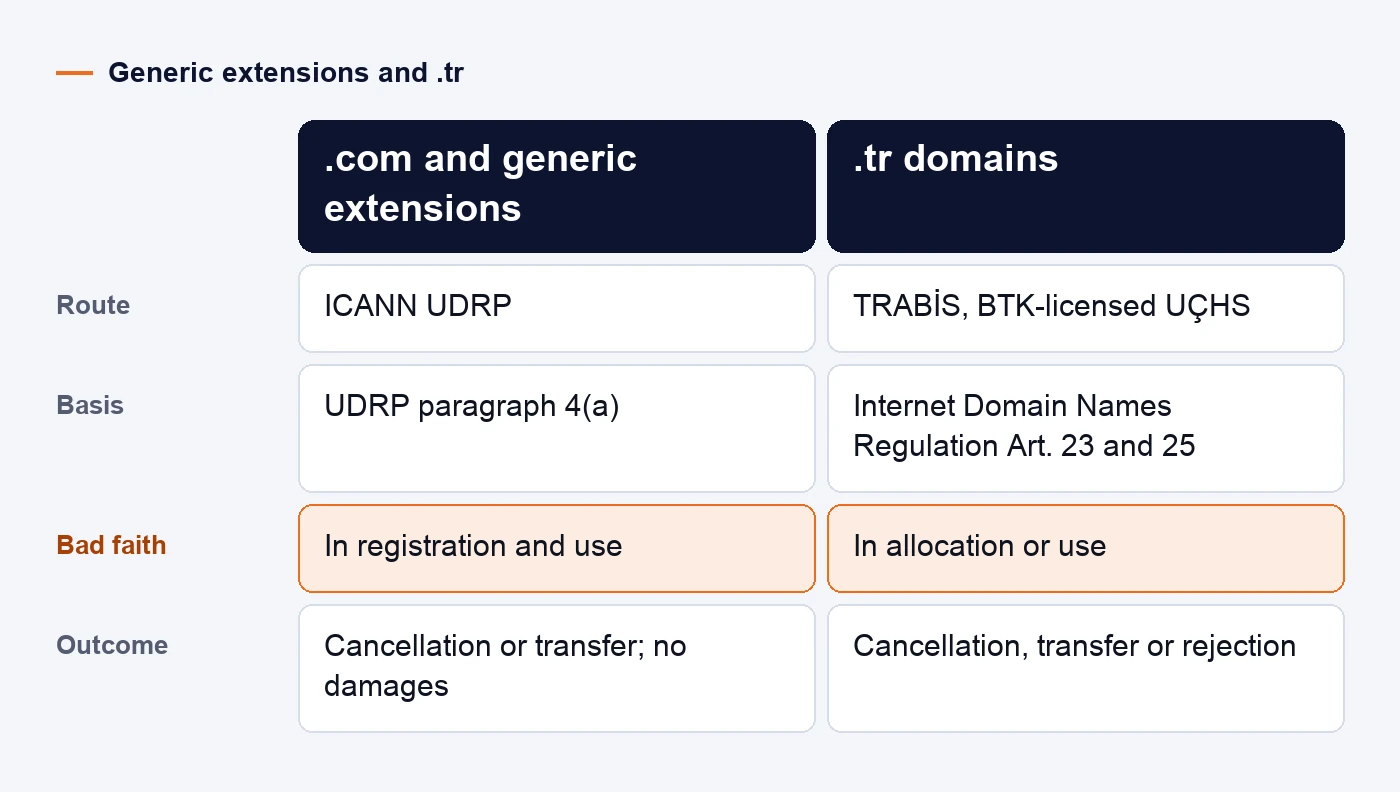
For generic extensions the route is ICANN's Uniform Domain Name Dispute Resolution Policy (UDRP). Under paragraph 4(a) of the policy, the complainant must prove three elements together:
- The domain name is identical or confusingly similar to a trademark in which the complainant has rights.
- The registrant has no rights or legitimate interests in the name.
- The domain name has been registered and is being used in bad faith.
The policy gives four examples of bad faith: acquiring the domain to sell it to the trademark owner or a competitor for more than its cost, preventing the trademark owner from reflecting its mark in a domain name, disrupting a competitor's business, and attracting users for commercial gain by creating confusion with the mark. The outcome available under the UDRP is cancellation of the domain or its transfer to the complainant; damages cannot be claimed this way.
How does the process work for .tr domains?
.tr domains are subject to the Internet Domain Names Regulation and are managed through TRABİS (.tr Network Information System), which the Information and Communication Technologies Authority (BTK) put into operation on 14 September 2022. Under Article 23 of the Regulation, disputes can be resolved through an alternative mechanism run by dispute resolution service providers (UÇHS) licensed by BTK; BTK sets its procedures.
The conditions in Article 25 resemble the UDRP: the domain is identical or similar to a trademark, trade name, business name or other distinctive sign owned or used in trade; the registrant has no legal right to or connection with the name; and the domain was allocated or is being used in bad faith. The difference lies in the last words. The UDRP looks for bad faith in both registration and use; the Regulation says "or". A .tr name registered in good faith and later used to target the brand may therefore fall within the mechanism.
The complainant applies to one UÇHS of its choice and cannot apply to another on the same matter until that provider has issued a final decision. The arbitrator or panel decides to cancel the domain, transfer it to the complainant or reject the request. The UÇHS notifies BTK and the parties of the decision within one day and publishes it on its website. Application fees are not refunded.
Which route is used for damages?
The alternative mechanisms are limited to cancellation and transfer. For damages or an order to stop infringement, trademark law applies. Article 7 of Industrial Property Law No. 6769 explicitly provides that, where the user has no right or legitimate connection, use of an identical or similar sign online as a domain name, routing code or keyword in a way that has commercial effect can be prohibited.
How do you keep a record the file can rely on?
Bad faith often shows in how a domain is used over time: a name that starts as a parking page and a few weeks later turns into a shop or a login form carrying the brand's logo. If that change is not recorded, only the final state remains in the file. Monitoring therefore stores the following signals with dates:
- newly registered domains containing the brand name or its common misspellings,
- content changing from a parking page to a shop or a login form,
- use of the brand's logo, product images and design elements on the site,
- use of the domain in ads, social media posts or bulk messages.
Why domain monitoring should be planned together with other channels is covered in the channels digital brand protection needs to cover.
How does Authex monitor domain names?
Authex scans domains resembling your brand, and copycat or misleading websites, across extensions, and compares their content, logo and design with your official assets. Findings are documented with the source link, a timestamp and, where possible, a screenshot, ranked by risk level, and the takedown process is tracked until it is resolved. Preparing a UDRP or UÇHS filing and the legal assessment are the work of a trademark attorney or lawyer; Authex provides the dated record those filings need. The scope is on the solutions page.
Sources
- WIPO, 2025 Marks Record-Breaking Year for WIPO Domain Name Disputes (14 January 2026)
- ICANN, Uniform Domain Name Dispute Resolution Policy
- Internet Domain Names Regulation (mevzuat.gov.tr, in Turkish)
- BTK, announcement on TRABİS starting operation on 14.09.2022 (in Turkish)
- Industrial Property Law No. 6769 (mevzuat.gov.tr, in Turkish)