Brand monitoring detects where and how your brand is used across digital channels. Brand protection takes each of those detections to a decision and an outcome: a removed listing, a closed account, a dealer who has been warned, or a finding deliberately left alone. In a process that produces reports but does not close findings, the brand sees infringements and cannot reduce them.
What does monitoring give you?
Which platforms mention the brand name, who lists its products, which accounts post in its name, which domains resemble it: monitoring gathers this information and produces a list of findings. However detailed the list, nothing changes until someone acts on it.
What steps make up protection?
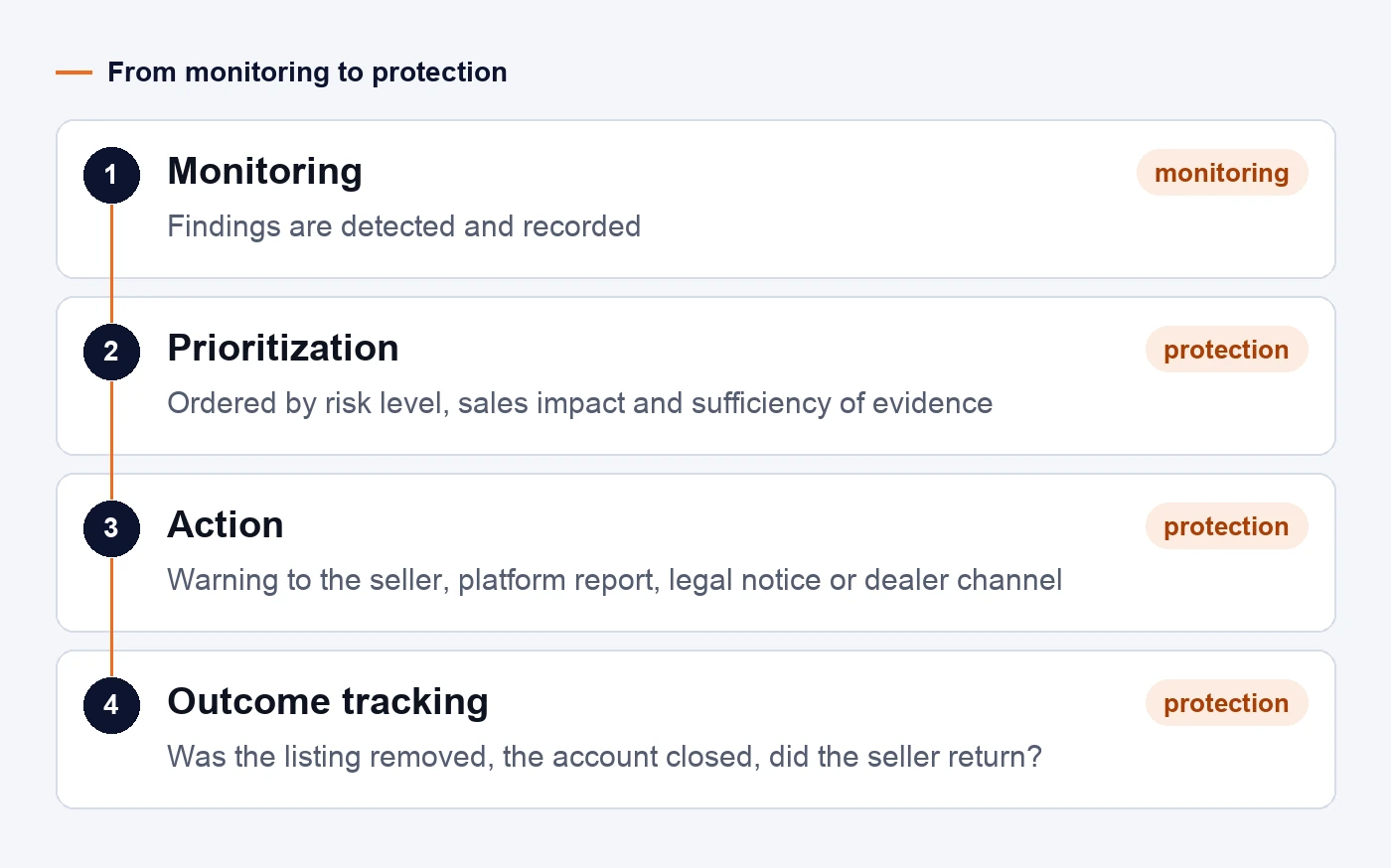
- Prioritization: ordering by risk level, sales impact and whether the evidence is sufficient.
- Action: a warning to the seller, a platform report, a legal notice or a message to the dealer channel.
- Outcome tracking: whether the listing was removed, whether the account was closed and whether the seller came back under another name.
Where does the gap usually open?
- Unsorted data: if hundreds of findings arrive with no priority, deciding which to handle first takes specialist time and most findings wait.
- Hand-offs between teams: the team that sees the finding and the team that acts on it (legal, sales operations, e-commerce) are different. If it is not defined who receives a finding, nobody owns it.
- Weak evidence: platforms ask for the listing link and a reason in a report. A finding that is only a screenshot, with no link and no date, does not meet that requirement.
How do you build the process from finding to outcome?
Every finding is recorded in the same layout: source link, timestamp, screenshot and risk level. Ranking is defined as a rule, so a high-risk finding does not sit in a waiting list. For each type of finding, who does what and within what time is written down. The outcome of a closed finding is recorded too; when the same seller or listing returns, the earlier case is found there.
The closing record is also the only way to measure the work. How many findings were closed, how long they took and which channel they recur in can only be read from that record.
In Authex, findings are ranked by risk level, assigned to team members, and their status is still monitored after your team or lawyer files a notice; the report for management is prepared from the same record.