An unauthorized seller is a person or company that sells a brand's product on marketplaces such as Trendyol and Hepsiburada without permission from the brand or its distribution network. You spot one by checking every store selling your brand against an up-to-date authorized seller list, and by reading signals such as price, listing content and store details together. The product is usually genuine; the problem lies in the channel it came through, the price it is sold at and who takes responsibility after the sale. That is why an unauthorized seller is not handled the same way as a counterfeit seller.
Step by step: how to spot unauthorized selling
- Build your authorized seller list with store names. For each dealer, record its store name on Trendyol and Hepsiburada, its trade name and its MERSİS or tax number.
- Search for your brand and products regularly. Search both marketplaces for the brand name, product names, model codes and common misspellings, and search more often during sales campaigns.
- Check each listing's seller against the list. Match the trade name and number on the store page with your authorized seller list.
- Compare the price with your list price. Put listings well below the recommended retail price first.
- Read the listing. Note whether your official images have been copied, whether the description was written for another market and whether the product appears under different variant names.
- Classify the finding. Is the seller authorized, unauthorized with a genuine product, or are there signs the product is fake?
- Record it and route it. Save the listing link, seller details, price and time of detection. Dealer-related cases go to the sales channel team; suspected counterfeits go to the legal team.
How do you identify a seller on Trendyol and Hepsiburada?
Under Article 5 of the Turkish e-commerce intermediary regulation, a merchant selling on a marketplace must show in full, in the space the marketplace assigns to it, at least one of its trade name, business name or registered trademark, its KEP (registered e-mail) address, and its MERSİS number (for companies) or tax number (for tradespeople). The rule applies on Trendyol and Hepsiburada alike.
These details are the real basis for the comparison. A store name is easy to change, but the trade name and MERSİS number identify the same business across marketplaces and store names. A seller trading under one name on Trendyol and another on Hepsiburada can then be treated as a single case, and you can see whether a dealer whose contract ended has carried on under a new store name.
On marketplaces where several sellers can make offers on the same product page, looking at the listing title is not enough; check the other sellers on the product page one by one.
Where do unauthorized sellers get the product?
In practice the sources are few:
- Stock meant for another market: product shipped to a different country or region that comes back outside the local distributor's channel.
- A dealer whose contract has ended: remaining stock cleared on a marketplace after the agreement expires.
- Bulk purchases: product sold to a business or wholesale buyer and then resold unit by unit on a marketplace.
- The lower end of the chain: a business that buys from an authorized wholesaler but has no permission to sell on marketplaces.
There is also the seller with no product at all: it copies the brand's images and description and ships the buyer something else. That case is handled as a counterfeit or misleading listing, not as unauthorized selling. The signals that give away a counterfeit seller are covered in how to detect counterfeit sellers.
Which signals appear together in listings?
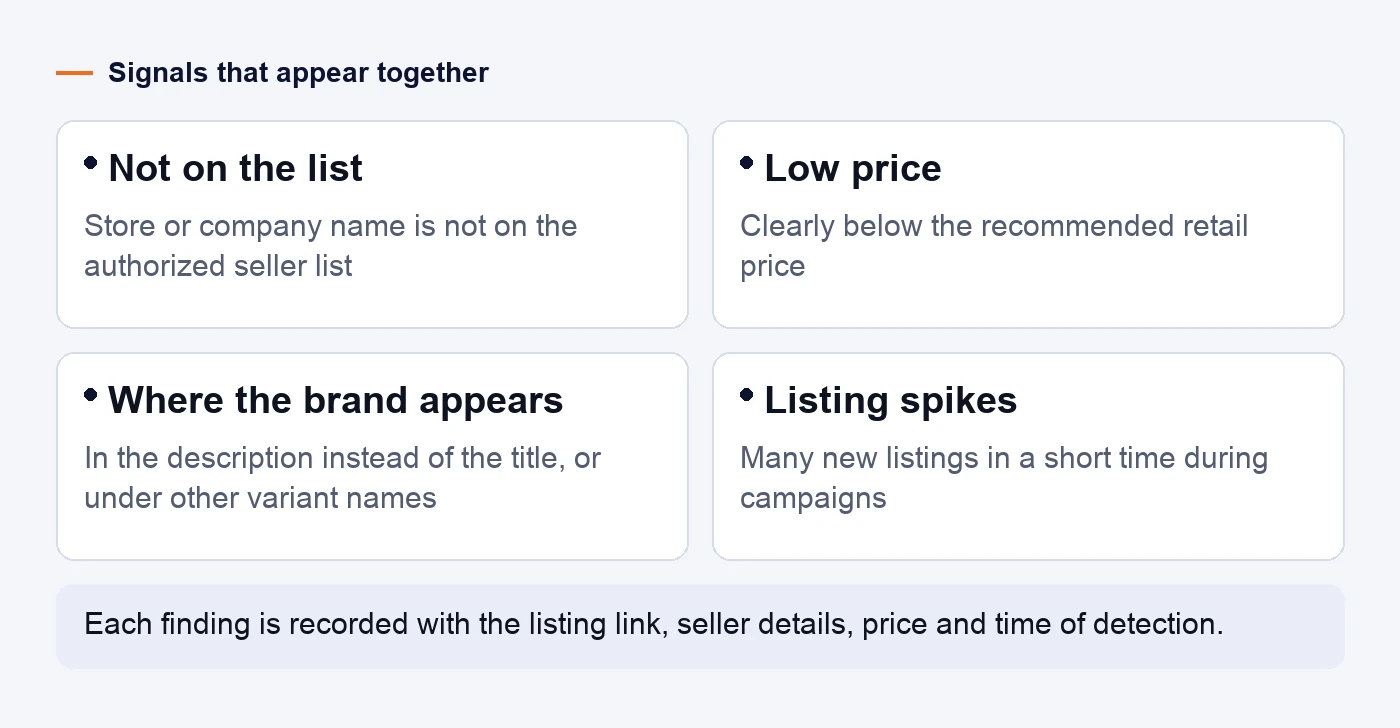
On its own, an unauthorized listing may look exactly like an authorized one. The distinction usually comes from several signals appearing together:
- the seller's store name or company name is not on the authorized seller list,
- the price sits clearly below the recommended retail price,
- the brand name appears in the description instead of the title, or the product is listed under different variant names,
- the packaging, label or description was made for another market,
- many new listings for the same product appear within a short time during campaign periods.
Listings and seller accounts change often, so this check is hard to keep up by hand. Each finding is recorded with the listing link, seller details, price and time of detection, and the next step is decided from that record.
What does unauthorized selling cost a brand?
The first effect is on price. With no dealer margin, marketing budget or service obligations, an unauthorized seller can go below the recommended retail price. An authorized dealer who looks more expensive on the same product page either cuts its price or complains to the brand, and either way the relationship with the distribution network wears thin.
The second effect shows up after the sale. Product from an unauthorized channel may be labelled for another market, stored in the wrong conditions or fall outside the brand's warranty. The customer buys it unaware and, when something goes wrong, turns to the brand. The risk is greater for products with a shelf life and storage conditions, such as cosmetics and food supplements.
What should you do once you spot one?
Reselling a genuine product outside the authorized channel is in most cases not a trademark infringement. Under Article 152 of the Industrial Property Code (Law No. 6769), acts relating to products put on the market by the right holder or with its consent fall outside the scope of the right, unless the product has been altered or impaired and used commercially. When the seller objects to the complaint with an invoice showing where the product came from, the marketplace republishes the product under Article 9 of Law No. 6563.
For that reason a finding of unauthorized selling is usually handled through the distributor and dealer agreements: you find which dealer the product came from and apply the contract's terms on sales channels and territory. If the product has been altered or repackaged, the listing presents itself as an official store, or there are signs the product is fake, the situation changes; that assessment belongs to the trademark attorney or lawyer.
If a complaint is the right route, the channels differ by platform. The channels and documents the right holder or its lawyer uses are covered in our guides to reporting on Trendyol and reporting on Hepsiburada. The overall sequence is in counterfeits on a marketplace: a step-by-step guide.
Why keep the authorized seller list current?
The authorized seller list is what detection rests on. If it is out of date, a dealer whose contract has ended still looks authorized and a new dealer looks unauthorized. Adding each dealer's marketplace store names, trade names and MERSİS numbers to the list lets the comparison run at listing level. A clear clause on marketplace sales in the contract makes the conversation with the dealer easier when a finding comes up. How cases with unclear authorization are classified is covered in authorized vs. unauthorized brand use.
How does Authex run this check?
Authex is an online brand-monitoring platform that detects unauthorised use of a brand across marketplaces, social media, ads and domains, collects the evidence and reports it. It monitors listings that use the brand name on marketplaces including Trendyol and Hepsiburada and compares the sellers with the authorized seller list you add, on every scan. Findings are recorded with a source link, a timestamp and a screenshot, ranked by risk level and assigned to team members. For each finding Authex prepares the evidence file and a draft notice; the brand's team or its lawyer decides whether to file it and files it. Whether a sale is a contract matter or a trademark infringement is decided by the brand owner and its attorney. See marketplace monitoring for the scope.
Frequently asked questions
Is unauthorized selling always a trademark infringement?
No. Reselling a genuine product after the right holder has put it on the market, or consented to that, usually falls outside the trademark right. It is different if the product has been altered or impaired.
How can I tell that stores on Trendyol and Hepsiburada belong to the same seller?
Compare the trade name, KEP address and MERSİS or tax number on the store pages. The regulation requires marketplace sellers to show these details.
What should I do first when I find an unauthorized seller?
Record the listing and the seller's details, then work out which dealer the product may have come from. Dealer-related cases point to the contract route; suspected counterfeits point to a complaint assessed with your trademark attorney.
How often should I check?
The law does not set a frequency. New listings appear quickly, especially during sales campaigns, so a regular check that steps up during campaigns is advisable.